
During Fleet Europe’s webinar on open-loop payments, supported by Visa, FLEET220 CEO Carolina Solcia joined Visa, Enfuce and Cardlay to explain how ODOS answers a problem fleet managers describe every day: too many cards for too many jobs.
Solcia opened by grounding the conversation in FLEET220’s own history. The company has managed fleets through their shift to electric since 2015, starting with an RFID card that let drivers charge across Europe the way a fuel card works for a company car. Talking to those managers is what surfaced the real need. Plug-in hybrid fleets wanted to pay for charging and for fuel, and they wanted to pay for tolls and everything else, without carrying a separate card for each. As Solcia put it, what customers asked for was “one card that can pay everything.”
That request became ODOS, built with Visa as the payment network, Enfuce as card issuer and processor, and Cardlay as the expense-management and control layer. Because ODOS runs on Visa, it works wherever Visa is accepted, which Solcia noted is “basically everywhere.” Each fleet keeps its own rules: the fleet manager sets spending limits per driver and decides which expenses are allowed and which are not.
Solcia was clear that ODOS is more than a payment card. It is coupled with an expense-management app and a fleet-manager platform, which removes the monthly cycle of paper receipts and manual reconciliation. Data arrives in real time, sorted by driver or category, so cost control and fraud checks happen as spending occurs rather than at month-end. She gave a concrete example: with a single payment method on a plug-in hybrid, a manager can see whether the driver is actually charging the car or running on fuel alone, which matters for any fleet serious about electrifying.
On fraud, Solcia explained that the RFID card is never a standalone credential. It is tied to an account, a phone and a person, and monitored accordingly. FLEET220 layers checks on top, including one based on car data: at the moment of charging, the system compares the vehicle’s location with the charging station’s, and flags a mismatch to the fleet manager. Her summary of an eleven-year-old market was steady rather than dramatic: the fraud exists, and the alarms are already built to catch it.
She also framed ODOS as a mobility card rather than a car-expense card. Because the team spoke with HR as well as fleet managers, ODOS was designed to collect an employee’s full mobility spend in one place, covering public transport, bus, metro, train, even flights, and extending to car sharing and bike sharing for employees who are less interested in owning a car. That flexibility lets HR build welfare and benefit plans that fit different generations of workers, and it opens a broader conversation about total cost of mobility rather than total cost of ownership.
Why ESG reporting belongs in this conversation
ODOS links every trip to the CO2 saved, because switching from fuel to EV or to rail avoids a measurable amount of emissions, and that data lands in the platform automatically. For companies, this is where a payment tool becomes a sustainability instrument. ESG reporting is no longer a voluntary gesture: under the EU Corporate Sustainability Reporting Directive, large companies and listed firms must disclose standardized environmental data, including Scope 1, 2 and 3 emissions, with mobility a direct contributor (source: Directive (EU) 2022/2464, CSRD). When emissions data is captured at the point of each trip rather than reconstructed at year-end, sustainability managers report from evidence instead of estimates. For FLEET220, a B Corp, that is the point: decarbonization is only credible when it is measurable, and ODOS is built to measure it.
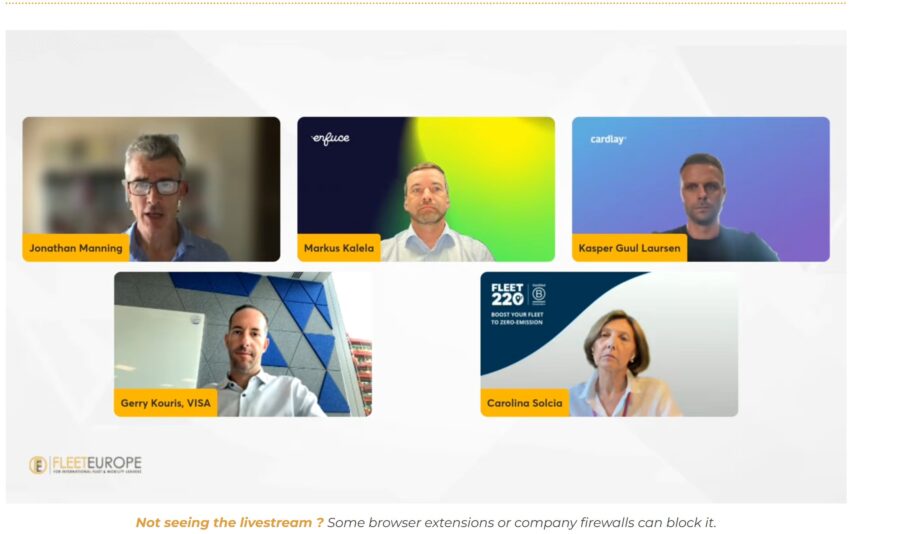
Watch the full Fleet Europe Webinar alongside the experts from Visa, Enfuce and Cardlay on the shift from closed-loop to open-loop